

ROME — When Joe Biden met Emmanuel Macron on Friday, there was clarification yet no apology.
AUKUS was “clumsy” and “not done with a lot of grace,” Biden said, but it was not quite a mistake.
The awkwardness over AUKUS — the U.S.-led Indo-Pacific strategic alliance that set off a bitter diplomatic feud with France — continued as Biden and Macron met in Italy, ostensibly to patch up a relationship that the two presidents said had already been patched up, but maybe could be repaired even more.
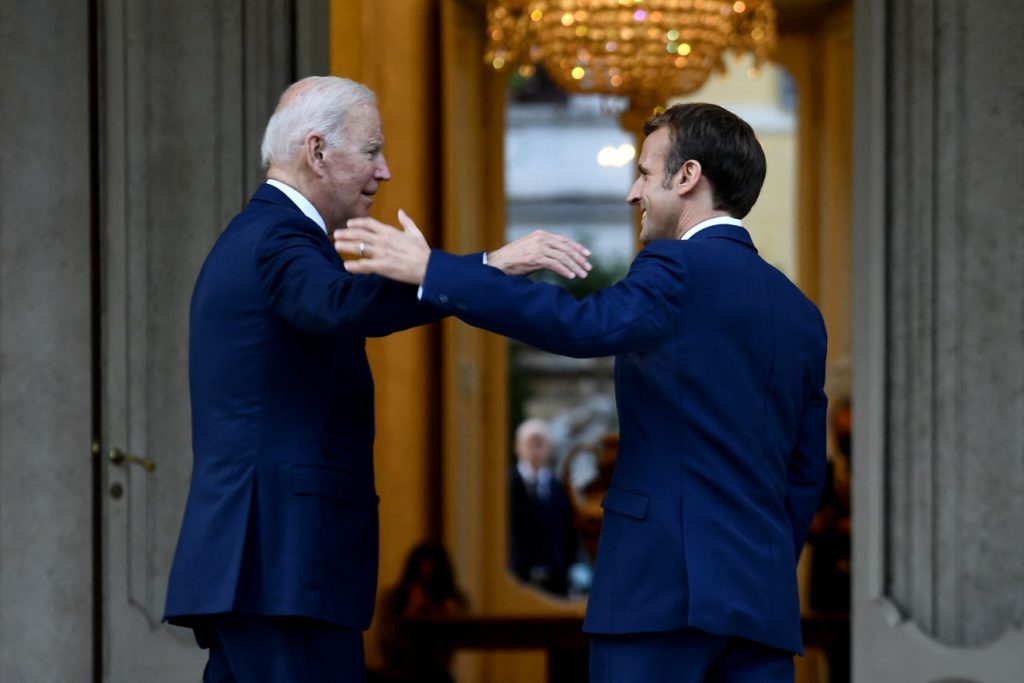
As Macron greeted Biden at Villa Bonaparte, the French embassy to the Holy See, a reporter asked the U.S. president if he needed to apologize. “To whom?” Biden replied.
Pressed on the point, Biden added: “We’ve already talked.”
Indeed, he and Macon had talked — by phone — twice since the whole ugly AUKUS business unfolded.
They spoke once in September when Biden acknowledged that France should have gotten a better head’s-up that it was going to lose a multi-billion dollar contract to build submarines for Australia, and also that the U.S. was going to announce its new Indo-Pacific partnership with Australia and the U.K. That conversation seemed to defuse the immediate tensions that had led France to recall its ambassador to the U.S. — the first time that had happened in the nearly 250-year-old relationship between the countries.
And they talked again just a week ago, as NATO defense ministers were gathered at the alliance headquarters in Brussels. A White House description of the call said: “They also discussed efforts to enable a stronger and more capable European defense while ensuring complementarity with NATO.”
But all that was just windup ahead of Friday’s tête-à-tête in Rome, ahead of the G20 leaders’ summit.
Or maybe it was a fret-a-fret.
France, for its part, was very keen on getting a solid commitment from the U.S. on maintaining what an adviser to Macron called “critical” military support for French operations in the Sahel. Despite Macron’s big talk about strategic autonomy, France relies heavily on U.S. intelligence and logistical support for its flagship anti-terrorism deployments in North Africa.
And Macron seemed especially intent on using Friday’s meeting with Biden to portray France and the U.S. as primary partners on a long list of security and other policy issues — efforts that he said Biden had confirmed in their recent conversations.
“Over the past few weeks, President Biden took some fundamental decisions, which benefitted our armies,” Macron said, adding: “We acknowledged some bilateral partnerships on armament exportations, the nuclear sector, the space industry, and, of course, the most advanced technology. And we want to have some extended cooperation on regulations, as well.”
“And then, we will continue to work together on the main international issues — climate change, the digital sector, health — which will be on the agenda of this G20,” Macron continued.
“And we will also upgrade our discussions on arms control, which remains a key issue. In a few words, this is what was at the heart of our work over the past few weeks — what we will be discussing today. These are very concrete decisions that are being taken to support some initiatives, some joint initiatives, joint actions on all of these matters.”
To underscore Macron’s points, the Élysée Palace and the White House followed up with a lengthy communiqué, signed by each president, detailing the various partnership initiatives, and an intent by the U.S. to “increase its support and material contributions” to French and European air and naval deployments in the Indo-Pacific.
But if Macron was fretting about making clear that France has rank, Biden was fretting that Paris was truly offended and he seemed to go overboard in providing reassurance, heaping praise on France and the U.S.-French military alliance, which dates back to the U.S. revolutionary war.
“We have no older or no more loyal, no more decent ally than France,” Biden said. “It’s been — you’ve been with us from the beginning. You’re the reason, in part, why we became an independent country.”
At another point, he said: “I want to make it clear: France is an extremely, extremely valued partner — extremely — and a power in and of itself.”
While powers don’t usually need to be reminded that they are powers, Biden was not letting up, and even invoked NATO’s mutual defense clause, Article 5, that says an attack on one ally is an attack on all.
“And so, I want to get something clear in front of all the press,” Biden said. “We view you as incredibly valuable, serious partners. Article 5 means everything to us. You were there for us; we’ll be there for you. There’s a lot more work we can do together, guaranteed.”
Macron, for the most part, seemed perfectly content with all that.
“We clarified together what we had to clarify,” he said in response to a question about whether he was satisfied that relations with the United States had been repaired (despite Biden’s apology-not-apology).
“Now what’s important is to be sure that such a situation will not be possible for our future,” Macron said. “This is an extremely important clarification.”
What remained less clear, despite all the presidential spin, was just how concretely the U.S. was willing to support the expansion of European defense capabilities, or whether France has the support of its European partners in its self-proclaimed effort to balance the EU-U.S. relationship.
As they met on the steps of the embassy, the two presidents put on a display of affection, at one point even briefly holding hands. That was followed by claps on the back, and they turned to walk away from the cameras each with an arm around the other’s shoulder.
As for the whole AUKUS affair, Biden said: “I was under the impression that France had been informed long before that the deal was not coming through.”
By that deal, he undoubtedly meant the cancellation of the submarine contract, which France had won by beating out Germany, its EU partner, and Japan, another G7 ally.
As for not telling Paris about the strategic partnership with the U.K. and Australia, Biden might have been referring to that when he said: “I think what happened was to use an English phrase … clumsy.” He added, “it was not done with a lot of grace.”
The meeting began with a roughly half-hour-long one-on-one between the two presidents and was followed by a 49-minute meeting of an expanded group, with six advisers on each side.
What was clear, though, was that the meeting was a much bigger deal for the French side than for the Americans.
French officials emphasized that the meeting was held at a French embassy, making Macron the host, and that they controlled the format.
The White House was a bit less attentive to detail, so much so that its guidance for journalists suggested that the meeting would be held at the French embassy to Italy, known as the Palazzo Farnese, rather than the French embassy to the Holy See, Villa Bonaparte.
In the end, the presidents and the countries emerged as friends, something that no one ever really thought was much in doubt. / Politico